


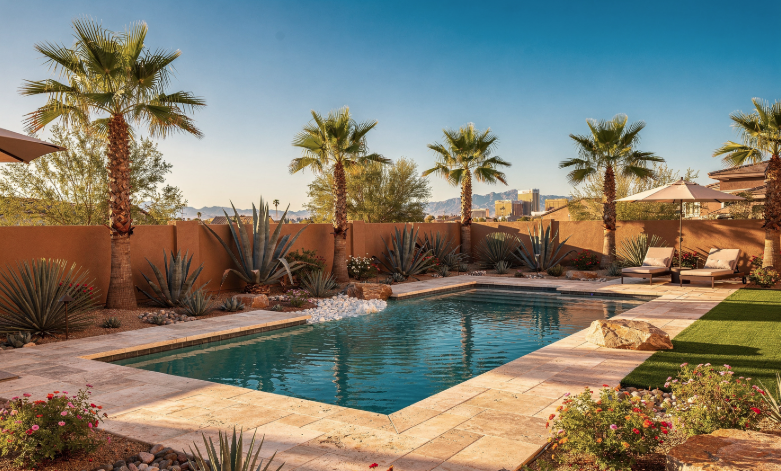
Picture this: You walk into a Las Vegas home, step through the back door, and there it is—a sparkling blue pool surrounded by desert landscaping and a covered patio.
Suddenly, the other houses you toured without pools don't seem quite as exciting.
In a place known for hot summers and outdoor living, it's easy to understand why a pool can move quickly from a "nice-to-have" to a "must-have."
But is a pool worth it in Las Vegas?
For the right homeowner, absolutely. A backyard pool can become a place to cool off, entertain friends, spend time with family, and enjoy your property differently. But a pool is also another major feature that requires maintenance, water, equipment, safety precautions, and money.
If you're house hunting in Las Vegas, here are seven things to consider before making a pool one of your non-negotiables.
Why Pools Are So Appealing in Las Vegas
There's a reason a pool looks so natural behind a Las Vegas home.
Southern Nevada's desert climate makes outdoor spaces an important part of how many homeowners think about their property. A pool can turn an ordinary backyard into an extension of the home.
Instead of driving somewhere to swim, you can step outside.
A pool can also become the centerpiece of an outdoor entertaining space with a patio, seating, shade, landscaping, or an outdoor kitchen.
But here's the important distinction:
Loving pools and loving pool ownership aren't necessarily the same thing.
Before paying more attention to homes with pools, think about what owning one will actually mean for your lifestyle.
1. Think About How You'll Actually Use the Pool
Start with the fun part.
Would you actually use it?
If you have children who love swimming, regularly entertain, exercise in the water, or simply enjoy spending summer afternoons outside, a pool could become one of your favorite features.
But if you travel frequently, rarely spend time outdoors, or would rather use the backyard for something else, that same pool could eventually feel like another item on your maintenance list.
Try imagining an ordinary week rather than a vacation.
How often would you swim?
Would friends and family use it?
Would you maintain it yourself or hire someone?
Do you want your backyard centered around a pool?
Would you prefer additional patio, garden, play, or open yard space instead?
The answer isn't about whether pools are "good" or "bad." It's about whether a pool fits the way you plan to live.
2. A Pool Is Another Part of the Home to Maintain
When buyers tour a pool home, their eyes naturally go to the water.
Look at the equipment, too.
Pools are systems. Pumps, filters, plumbing, surfaces, heaters where present, cleaning equipment, lights, and other components can require maintenance or eventual replacement.
Routine ownership may involve cleaning, monitoring water chemistry, checking equipment, and addressing repairs when they arise.
You may choose to do some of that yourself or hire a pool service.
Either way, include pool ownership in your housing budget rather than treating it as a free amenity that happens to come with the house.
And be careful with generic online claims such as "a pool costs exactly $X per month." Actual expenses vary depending on pool size, equipment, condition, usage, service arrangements, heating, repairs, and other factors.
When considering a particular home, getting property-specific information is far more useful than relying on a national average.
3. Water Use Matters in Southern Nevada
This is where buying a pool in Las Vegas becomes different from buying one in many other parts of the country.
Southern Nevada operates in an extremely dry environment, and outdoor water use is particularly important because water used outdoors can be lost through evaporation rather than captured and recycled like indoor water.
The Southern Nevada Water Authority specifically recommends using pool covers to reduce evaporation. It also recommends checking pools for leaks and avoiding excessive heating, since warmer water can increase evaporation.
For a prospective homeowner, that means water efficiency deserves a place in the conversation.
Ask whether the current owners use a pool cover. Look at the pool's size. Ask about unusual water loss or known leaks. Examine the surrounding landscaping and irrigation as part of the overall property's outdoor water use.
There's another interesting fact buyers should know: Southern Nevada has adopted restrictions affecting the size of new residential pools.
The Southern Nevada Water Authority approved a resolution supporting a maximum surface area of 600 square feet for new residential pools, and local jurisdictions subsequently implemented related rule and code changes. SNWA says the average Southern Nevada swimming pool is about 475 square feet.
That's particularly relevant if you're comparing buying a home that already has a pool with purchasing a home and planning to build one later.
4. Inspect the Pool, Not Just the House
Imagine finding what seems like the perfect Las Vegas home.
The kitchen is updated. The HVAC looks good. The roof checks out.
And then, after closing, you discover the backyard pool needs significant work.
That's why buyers shouldn't let clear blue water substitute for due diligence.
A standard home inspection and a specialized pool evaluation aren't necessarily the same thing. Depending on the property, buyers may want an appropriately qualified professional to evaluate the pool and its equipment.
Questions worth investigating include:
- What condition is the pool surface in?
- Is there visible cracking or deterioration?
- Is the pool losing water unexpectedly?
- How old is the pump?
- What condition is the filter in?
- Does the heater work, if there is one?
- Are the lights functioning?
- Are there visible leaks?
- What condition are the deck and surrounding surfaces in?
- Are safety barriers and gates appropriate?
Don't assume an attractive pool is a healthy pool.
Think of it like the home's air-conditioning system: you want to know what you're buying before it becomes your responsibility.
5. Pool Safety Deserves Serious Attention
If a property has a pool, safety needs to be part of the purchase decision—particularly for households with young children or frequent child visitors.
Clark County emphasizes multiple layers of pool protection, including active adult supervision and appropriate barriers. Its guidance discusses features such as non-climbable fencing, self-closing and self-latching gates, door and window protections, and properly secured access to pool areas.
Building requirements can depend on the property's jurisdiction and circumstances, so buyers should verify what applies to the particular home rather than relying on a generic checklist.
When you're touring a property, don't simply ask, "Does it have a fence?"
Look at how someone gets from the house to the water.
Can a child reach the pool directly from a door?
Do gates close and latch properly?
Are there doors, windows, pet doors, furniture, or other features that affect access?
Pool safety is one area where "we'll deal with that after moving in" isn't a particularly good plan.
6. Don't Assume a Pool Automatically Adds Value
Here's one of the biggest real estate questions:
Does a pool increase the value of a Las Vegas home?
Potentially—but don't assume there's a universal dollar amount.
The effect can depend on the property, neighborhood, buyer demand, pool condition, lot size, outdoor space, and comparable sales.
For one buyer, a beautifully maintained pool could be a major selling point.
For another, it might represent maintenance and expense they'd rather avoid.
That makes broad claims like "a pool adds $50,000 to a Las Vegas home" unreliable without market-specific evidence.
If you're evaluating a particular property, ask your real estate professional to look at relevant comparable sales and how pool and non-pool homes are behaving in that specific area.
A pool should make sense for your lifestyle first. Any potential resale benefit should be evaluated using the actual property and local market data.
7. Buying a Pool Home vs. Building One Later
Some buyers think, "I'll buy the house I like and add a pool later."
That may be possible, but don't assume it will be simple.
First, determine whether the property can accommodate the pool you want.
Lot dimensions, setbacks, utility locations, easements, access for construction equipment, HOA requirements, permitting, landscaping, and local codes can all affect what's possible.
Then remember Southern Nevada's restrictions on new residential pool surface area.
The current 600-square-foot limit supported by SNWA applies to new residential pools through rules adopted by participating local jurisdictions.
So if your dream is a particularly large backyard pool, verify what's permitted before buying a property based on plans to add one.
This is one reason an existing pool can be attractive: you can see exactly what you're getting.
On the other hand, buying without a pool lets you decide whether you want one at all rather than paying for a feature someone else chose.
Pool Home vs. No Pool: Which Fits You?
| Consideration | Home With a Pool | Home Without a Pool |
|---|---|---|
| Backyard recreation | Immediately available | Requires other options |
| Maintenance | Additional ongoing responsibility | Less pool-related upkeep |
| Water use | Higher outdoor water considerations | No pool evaporation |
| Safety | Requires pool-specific precautions | No residential pool hazard |
| Yard space | Pool occupies part of yard | More flexible outdoor space |
| Future construction | Pool already exists | Could potentially add one, subject to rules |
| Equipment | Pumps, filters and other components | No pool equipment to maintain |
| Lifestyle | Great for buyers who will use it | Better for buyers who won't |
There's no winner here.
The better choice is the one that matches your lifestyle and budget.
What to Ask Before Buying a Las Vegas Home With a Pool
When you find a pool home you love, ask for as much property-specific information as reasonably available.
Find out approximately when the pool was built and whether the seller has records for major repairs or equipment replacement.
Ask about the pump, filter, heater, automation, lighting, and other installed equipment.
Look at the surrounding deck and landscaping.
Find out how the pool is maintained and whether the owner has experienced leaks or other known problems.
Check the safety barriers and determine which current requirements apply to that property.
Most importantly, make your evaluation part of the broader home-buying process.
A gorgeous pool shouldn't cause you to overlook the house attached to it.
FAQs About Buying a Home With a Pool in Las Vegas
Is a pool worth it in Las Vegas?
A pool can be worth it for buyers who expect to use it frequently and are comfortable with the maintenance, water use, safety responsibilities, and operating expenses. Buyers who don't expect to swim often may prefer additional usable yard space and fewer maintenance responsibilities.
Does a pool add value to a Las Vegas home?
It can influence a property's appeal and value, but there isn't one amount that applies to every Las Vegas home. Neighborhood, pool condition, lot, comparable sales, and current buyer demand all matter. Property-specific comparable sales are more useful than broad national estimates.
Should I get a pool inspection before buying a home?
Buyers considering a pool property should understand exactly what their general home inspection covers. Depending on the property, a specialized evaluation by an appropriately qualified pool professional may provide additional information about the pool, equipment, surfaces, leaks, and other components.
How big can a new residential pool be in Las Vegas?
Southern Nevada jurisdictions have implemented restrictions based on an SNWA resolution supporting a 600-square-foot surface-area limit for new residential pools. Rules can depend on jurisdiction, so homeowners planning a new pool should verify current requirements for their specific property before construction.
Do Las Vegas pools lose water to evaporation?
Yes. Evaporation is an important consideration in Southern Nevada's dry climate. SNWA recommends pool covers, leak detection, wind protection where practical, and conservative heating as ways to reduce water loss.
What should I look for when touring a Las Vegas pool home?
Look beyond the water itself. Pay attention to pool surfaces, decking, equipment, visible leaks, fencing, gates, shade, landscaping, and how easily the pool can be accessed from the house. Obtain appropriate inspections before purchasing.
Is it better to buy a home with a pool or build one later?
Buying an existing pool lets you evaluate the finished feature before purchasing. Building later gives you more control over the design, but the project may be affected by lot dimensions, permitting, HOA requirements, access, costs, and Southern Nevada's rules for new residential pools.
Are pool fences important in Las Vegas?
Yes. Clark County emphasizes barriers as an important layer of drowning prevention and provides guidance on pool fencing, gates, alarms, and other protections. Specific code requirements should be confirmed for the property's jurisdiction.
So, Is a Pool Worth It in Las Vegas?
For some buyers, a pool is exactly what makes a Las Vegas house feel like home.
For others, the maintenance, safety responsibilities, equipment, and water considerations make a pool less appealing than a larger patio or more flexible backyard.
The key is not deciding whether pools are worth it in Las Vegas in general.
It's deciding whether a pool is worth it for you.
If you're searching for a Las Vegas home, compare both pool and non-pool properties before making it a must-have. Look beyond the listing photos, investigate the pool's condition, understand the responsibilities that come with it, and make sure the entire property—not just the backyard—fits your lifestyle and budget.
Check out this article next